
What Airbus’s First Hydrogen Airliner Means for the Hydrogen Economy

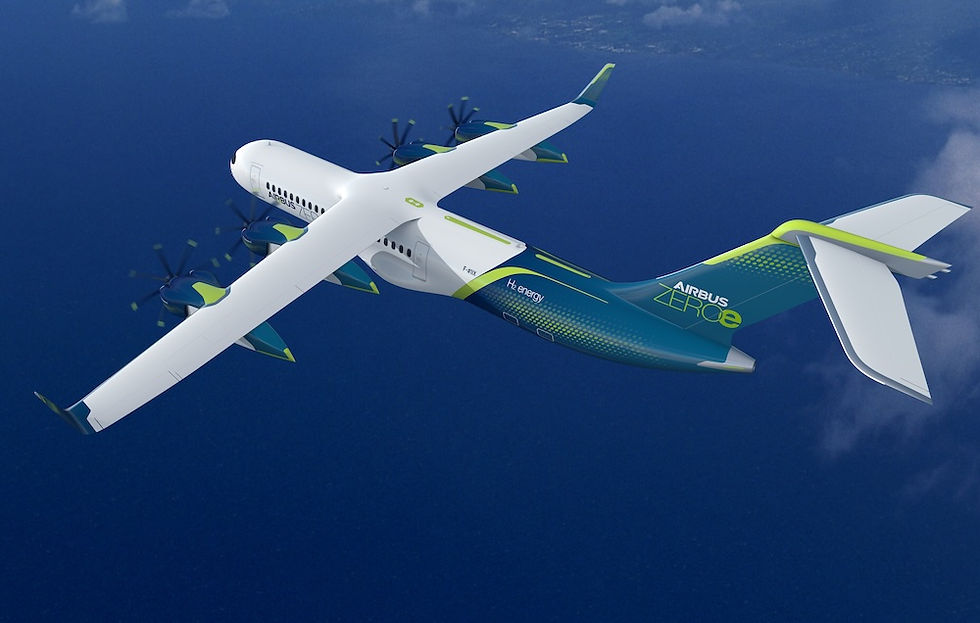
Photo: Airbus
Airbus has given the market its clearest hint yet about the size of its first hydrogen airliner. Speaking in October 2026, Airbus commercial aircraft chief Lars Wagner said the company’s initial propeller-driven hydrogen fuel cell aircraft will likely carry around 80 passengers, adding that the zero-emission design is “becoming a reality” (Kaminski-Morrow, 2026). Wagner declined to share the configuration or engine count, citing the competitive nature of the project. Even so, the seat count tells hydrogen producers, airports and investors where aviation demand for hydrogen will first appear.
From Bold Concepts to a Realistic First Step
The 80 seat figure marks a deliberate narrowing of ambition. When Airbus launched its ZEROe program in 2020, it showed three concepts: a turbofan for 120 to 200 passengers, a turboprop for up to 100 passengers and a blended wing body for up to 200 passengers (CompositesWorld, 2025). In February 2025, the company pushed its original 2035 service target back by as much as a decade, to a window of roughly 2040 to 2045, explaining that the wider hydrogen ecosystem was developing “slower than anticipated” (CompositesWorld, 2025).
A month later, at the 2025 Airbus Summit, the company confirmed that fuel cell electric propulsion was its preferred path. Its notional concept used four electric engines rated at 2 MW each, every one driven by its own fuel cell system and supplied from two liquid hydrogen tanks (Airbus, 2025). That followed a 2023 milestone in which Airbus ran a 1.2 MW fuel cell system at full power in Ottobrunn, Germany, which the company described as the highest output ever produced by an aviation fuel cell system (AirInsight, 2023).
In July 2026, Airbus and MTU Aero Engines announced plans for a joint venture to develop, certify and commercialize a fully electric hydrogen fuel cell propulsion system, with operations expected to begin in 2027 (Airbus, 2026). Bruno Fichefeux, Airbus head of future programmes, said the venture “will help secure strategic sovereignty in the next generation of aviation technologies” (Airbus, 2026). Wagner’s comment now frames that engineering work.
Why 80 Seats Is the Right Size
An 80 seat turboprop sits squarely in regional aviation, the segment that connects secondary cities, islands and remote communities on routes typically under a few hundred miles. These flights are short, frequent and predictable, which suits fuel cell propulsion because liquid hydrogen tanks take up more volume than kerosene for the same energy. Regional routes also concentrate operations at a limited number of airports, which makes fueling infrastructure easier to plan than for a global long haul network.
Fuel cells deliver quiet, efficient power without combustion emissions, but power density and thermal management remain hard problems at airliner scale. AirInsight (2023) reported that Airbus engineers still faced challenges in engine mass, stack efficiency and operating temperature. Starting with a smaller aircraft reduces technical risk and offers a credible path to certification, which in aviation is often the true bottleneck.
The So What for the Hydrogen Economy
The first implication is that aviation is becoming a defined, if modest, offtake market for liquid hydrogen. Liquefaction is energy intensive and costly, and most current hydrogen projects produce gaseous product for refineries, ammonia or steel. An airline fleet of 80 seat fuel cell aircraft would require reliable liquid hydrogen supply at specific airports on specific schedules. That creates a bankable demand signal for regional liquefaction plants and cryogenic logistics, exactly the kind of anchor customer that hydrogen developers struggle to secure.
The second implication is geographic. Regional aviation hubs, particularly in Europe, Scandinavia, island nations and parts of the Gulf, could become early hydrogen valleys where airports, bus fleets, ports and industrial users share production and storage. Airbus has long argued that the aircraft cannot succeed without a parallel ecosystem, and its 2025 statement emphasized advocacy for the regulatory framework needed for hydrogen aircraft to fly (Airbus, 2025). Airports that begin planning now will be positioned to capture that investment.
The third implication concerns supply chains and sovereignty. The Airbus and MTU venture covers fuel cell powertrains from development through maintenance (Airbus, 2026). Fuel cell stacks, power electronics, cryogenic tanks and hydrogen distribution systems for aircraft will form a new industrial value chain. Suppliers of electrolyzers, membranes, catalysts and composite tanks for ground transport stand to benefit from aerospace grade demand and the quality standards that come with it.
Patience Is Part of the Business Case
None of this will happen quickly. With service entry now expected in the 2040s, near term aviation decarbonization will rely mainly on sustainable aviation fuel, some of which itself depends on green hydrogen through power to liquid pathways. That overlap matters. Hydrogen producers serving e-fuel makers in the 2030s can build the scale, workforce and cost reductions that later supply liquid hydrogen directly to aircraft.
Wagner’s comment is brief, but it converts a long term vision into a specific product with a specific market. For the hydrogen economy, an 80 seat regional airliner means a clearer demand profile, a defined set of early adopter airports and a strong reason to invest in liquefaction and cryogenic infrastructure. Investors, airport authorities and policymakers who treat this as a 2040s problem may find that the decisions shaping it are being made today.
References
Airbus. (2025, March 25). Airbus showcases hydrogen aircraft technologies during its 2025 Airbus Summit [Press release]. https://www.airbus.com/en/newsroom/press-releases/2025-03-airbus-showcases-hydrogen-aircraft-technologies-during-its-2025
Airbus. (2026, July 7). Airbus and MTU Aero Engines to create a joint venture to develop a fully electric hydrogen fuel cell engine [Press release]. https://www.airbus.com/en/newsroom/press-releases/2026-07-airbus-and-mtu-aero-engines-to-create-a-joint-venture-to-develop-a-fully-electric-hydrogen-fuel-cell
AirInsight. (2023, June 24). Airbus’s hydrogen system reaches required power output. https://airinsight.com/airbuss-hydrogen-system-reaches-required-power-output/
CompositesWorld. (2025, February 18). Airbus pushes ZEROe aircraft project timeline to 2040s. https://www.compositesworld.com/news/airbus-pushes-zeroe-aircraft-project-timeline-to-2040s
Kaminski-Morrow, D. (2026, October 18). Airbus’s initial hydrogen airliner likely to have 80 seats: Wagner. FlightGlobal. https://www.flightglobal.com/aircraft-programmes/2026/10/airbuss-initial-hydrogen-airliner-likely-to-have-80-seats-wagner/


Comments