
India's Hydrogen Train Debut: The Real Signal Behind the Namo Green Rail

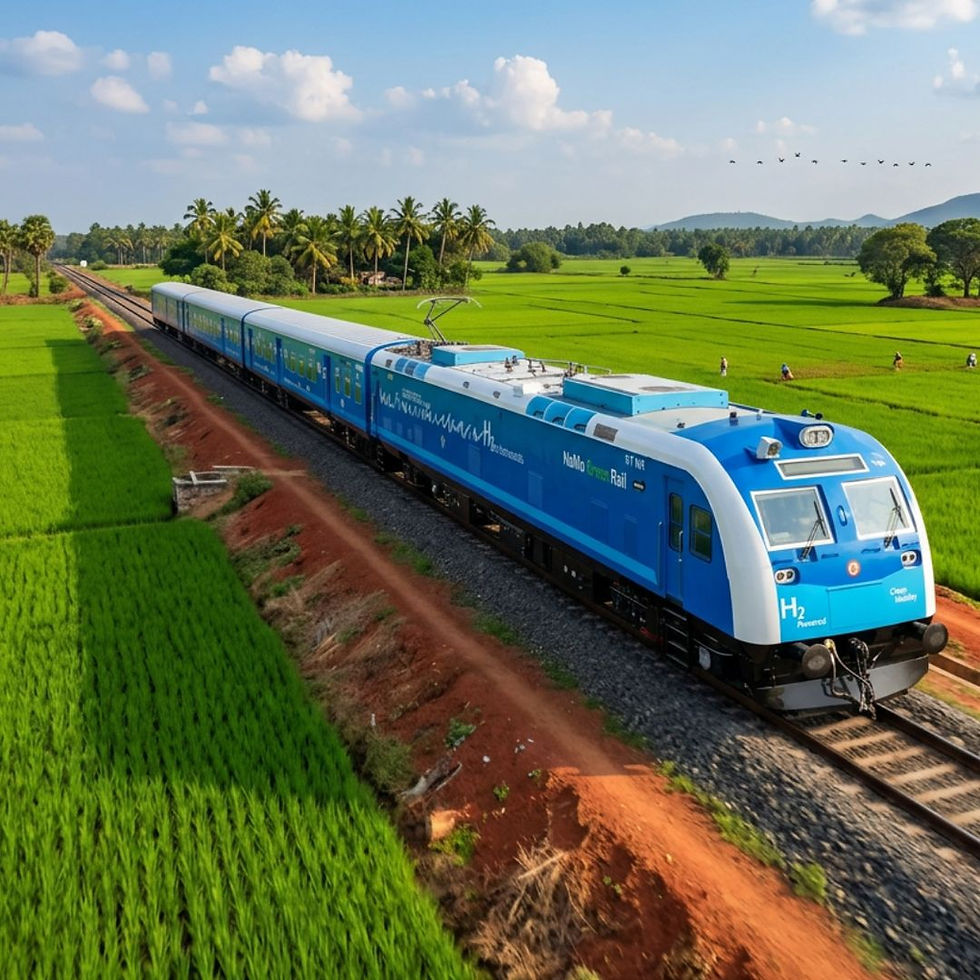
On July 17, 2026, Prime Minister Narendra Modi will flag off the Namo Green Rail at Jind Railway Station in Haryana, sending India's first indigenously built hydrogen fuel cell train into daily passenger service. The headline is a train. The substance underneath it is a live demonstration that hydrogen can be produced, stored, dispensed, and consumed safely at industrial scale, on a fixed schedule, in front of the public. That is the detail worth paying attention to if you care about where the hydrogen economy is actually heading, rather than where it has been promised to go for the past decade (Press Information Bureau, 2026).
The technical picture is straightforward. The ten car trainset carries a 1,200 kilowatt hydrogen fuel cell propulsion system and 27 onboard hydrogen cylinders, giving it a range of roughly 250 kilometers per fill and a top speed of 75 kilometers per hour. It will run the 89 kilometer Jind to Sonipat corridor under Northern Railway's Delhi Division six days a week, completing the route in about an hour compared to the two hours needed by the diesel multiple unit service it replaces. Ticket prices will run from Rs 5 to Rs 25, and the train is rated to carry about 2,500 passengers. It was engineered by the Research Designs and Standards Organisation in Lucknow and built at the Integral Coach Factory in Chennai, at an estimated cost of Rs 89 crore (Jaiswal, 2026; Press Information Bureau, 2026).
None of those numbers, on their own, reorder the global energy map. What matters is the infrastructure standing behind them. Indian Railways has built a dedicated hydrogen storage and refueling facility at Jind, licensed by the Petroleum and Explosives Safety Organisation for compressed gas storage and dispensing. The site runs a hydrogen compression system with a standby compressor, leak detectors, flame sensors, and round the clock monitoring, consuming close to 300 kilograms of hydrogen a day to keep the train fueled. That is a working hydrogen supply chain, not a pilot bench in a lab. It is the unglamorous part of the hydrogen economy, production logistics, safety certification, and refueling cadence, that has always been the harder problem than building a fuel cell stack (Press Information Bureau, 2026).
So what does this mean beyond Haryana. First, it is a signal to industry and investors that hydrogen mobility can clear real regulatory and safety hurdles in a large, cost sensitive market, not just in wealthy countries with mature hydrogen strategies. India now joins Germany, Japan, China, and the United States among the small number of nations operating or testing hydrogen powered rail, and it does so with a domestically designed and domestically manufactured train, which changes the calculus for other developing economies watching from the sidelines (FuelCellsWorks, 2026). Germany's Coradia iLint fleet and Japan's fuel cell rail trials proved the concept could run technically. What India adds to that record is scale and cost discipline: a fare of a few rupees, a state run operator, and a supply chain built almost entirely with domestic manufacturing and domestic regulatory approval. If India can certify hydrogen storage and dispensing under its own regulatory regime and run it daily on a public budget, that playbook becomes exportable to the many middle income countries that cannot afford Western European price tags for the same technology.
Second, rail is a useful proving ground precisely because it sits between two harder hydrogen use cases: light vehicles, where battery electric competitors have mostly won on cost and charging convenience, and heavy freight or shipping, where hydrogen's energy density advantage matters most but the infrastructure lift is enormous. A fixed route with predictable refueling needs, like Jind to Sonipat, lets operators de-risk hydrogen logistics without solving the harder problem of nationwide fueling networks. Every successful cycle of that pilot builds an evidence base that project financiers, insurers, and safety regulators can point to when the next route, or the next country, asks whether hydrogen rail is bankable.
Third, this is squarely a policy story as much as an engineering one. The launch is being framed inside India's Green Transport Mission and its Make in India manufacturing push, and it is explicitly tied to the country's net zero commitments. That framing matters because hydrogen projects tend to live or die on sustained public investment through the expensive early years before unit costs fall. A flagship project with a Prime Minister at the ribbon cutting tends to survive budget cycles that quieter pilot programs do not.
None of this guarantees hydrogen wins the broader race for clean transport. Green hydrogen remains expensive to produce at scale, and rival pathways, ammonia, methanol, LNG, biofuels, battery electrification, are all competing for the same decarbonization budget across shipping, aviation, and heavy industry. What the Namo Green Rail actually proves is narrower and more useful: that a hydrogen fueling and safety system can be built, licensed, and operated reliably in a real world, cost constrained transit setting. If the pilot holds up over its first year of daily operation, expect Indian Railways to extend hydrogen trainsets to other short haul routes, and expect other countries building their own hydrogen roadmaps to study Jind as a working case file rather than a concept paper. That shift, from white paper to timetable, is the quiet part of the hydrogen economy that moves markets.
References
FuelCellsWorks. (2026, May 26). *India launches first hydrogen powered train*. https://fuelcellsworks.com/2026/05/26/energy-innovation/india-clears-launch-of-first-hydrogen-train
Jaiswal, A. (2026, July 7). *Indian Railways to launch country's first hydrogen train on July 17: Know route, fare and other details*. India TV News. https://www.indiatvnews.com/business/news/indian-railways-to-launch-country-first-hydrogen-train-on-july-17-know-route-fare-and-other-details-2026-07-07-1047369
Press Information Bureau. (2026, May 27). *Greener and more energy efficient: First indigenous hydrogen train all set to start*. Ministry of Railways, Government of India. https://www.pib.gov.in/PressReleasePage.aspx?PRID=2265781


Comments